Advanced Planetary Magic
by Jason Miller
Published Jan. 1, 2013
Ratings:
- Content: 2/2
- Ease of Reading: 1.5/2
- Accuracy: 2/2
- Editing: 0/2
- Enjoyment: 2/2
Total: 7.5/10
What's Covered in Advanced Planetary Magic
This book is broken down into 4 chapters with an appendix. Chapter 1 includes a little bit of basic planetary information for the traditional 7 planets to get the reader up to speed with what's expected to be known. This includes the Chaldean order, planetary days, and planetary hours. In the second chapter, Miller introduces the concept of using Greek vowels and mapping them to the planets. He presents three ways to do so, and establishes which mapping will be used throughout the book.
New planetary seals are introduced in Chapter 3. These seals were developed by him and a collaborator, Matthew Browlee. Each seal has a brief description and includes five areas where the seals can be applied to, demonstrating the versatility of the planets. Lastly, Chapter 4 makes up the bulk of the book (about 50%) and is a list of 49 calls to the planets.
My Review
This book was read in March 2022 and reread in March 2026 for this review.
True to the title of the book, this is indeed an advanced text in that it requires previous knowledge of planets and planetary magic, rather than anything in the book being beyond the skillset of a beginner. While there is some introductory information about necessary concepts (including a section on each planet), the information is brief and written as context for Chapters 3 and 4 of the book, rather than information a beginner can learn from.
To my personal practice, Chapter 3 and the revelation of the new planetary seals is one of the more exciting and enlightening parts of the book. These planetary seals are meant to embody the energies of the planets themselves, not just the spirits or intelligences associated with the planets. Some of the seals are reminiscent of their standard planetary glyphs, but these seals are beautiful and fluid. The shapes in the seals are evocative of the planets' energies in such a way that makes them easy to instantly recognize.
In some writing systems, like kanji in Japanese, stroke order when making each symbol is imporant. I do wonder if there is an order that should be followed when making the different strokes of the seals. I imagine it would be down to experimentation, but I would have liked to have read about Miller's experience. It may not matter, but I find it an interesting question nonetheless.
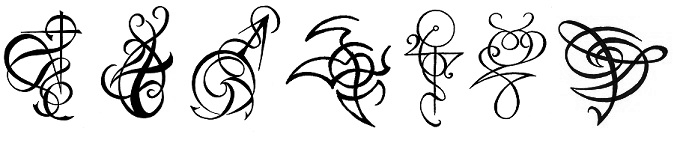
Image from Jason Miller's website. Seals from left to right: Saturn, Jupiter, Mars, the Sun, Venus, Mercury, the Moon.
The previously mentioned Greek vowel mapping is used in a ritual for "the management of planetary energies" which I suppose is the beginning of a ritual where the purpose depends on which of the 49 calls is being used. About half of the book is made up of these 49 calls, which are spells written as recitations to be performed on specific day and planetary hour.
A note on my accuracy rating: This book does not include a bibliography, as the bulk of the book is original from Miller's own courses. It does not claim to be a historical text and refers to outside sources if you want to learn more about astrology or the planets, so I gave it a 2.
Final Thoughts
This book is an excellent text that is both practical and easy to read. I will say this text needed an editor badly. There are plenty of grammatical and spelling mistakes throughout the book, and while it did distract me when reading, it didn't take away from the value the book provides. The content is unique and not presented anywhere else since it is content straight from Miller's courses. If you are a planetary witch or someone who works with the planetary energies, I highly recommend adding this book to your repetoire.
You can buy a digital version of the book on Jason Miller's website here.
Page last updated: April 1, 2026